Tag: opt out

Texas Children Deserve Better


by Jennifer Rumsey
March 24, 2016

special to txedrights.net

It’s that time again. Time for STAAR testing in Texas. STAAR is the legislatively mandated series of high-stakes tests for public school children in Texas, and it is the most recent and most difficult of several testing program iterations that began in the 1980’s. I have been a Texas public school teacher since 1999. I have experienced TAAS, TAAS prep, TAAS workbooks, TAAS-aligned textbooks, TAAS packets, and even a TAAS pep rally.

Once students’ statewide overall scores became pretty high, the legislature made the costly move (paid to Pearson) to TAKS. The public schools adjusted: we adopted TAKS-aligned textbooks (published by Pearson), bought TAKS workbooks, held TAKS bootcamps and tutorials. During this time, the lawmakers instilled the Student Success Initiative (SSI), claiming that 5th and 8th grade students would “benefit” by being required to pass the TAKS reading and math tests. If students don’t pass, don’t worry…they “get” two more tries to pass the tests. But if they fail it repeatedly, these children can be retained in grade. Nevermind that research shows that students who are retained are more likely to suffer from low self-esteem and to dropout of high school.

And then there was STAAR, the most ambitious testing program yet. The Texas legislature decided to gut public education funding that year, 2011. The cuts amounted to a loss of$5.4 billion, while they voted to create STAAR and pay Pearson $500,000,000.00. At first adoption, high school students were required to pass 15 End of Course exams to graduate. Now, thanks to grassroots efforts to change excessive testing requirements, high school students only take 5 graduation exams. However, their future life success remains impacted by rules that they must pass these exams to graduate, even with their Carnegie credits earned.

Tuesday my freshmen students must take the 5 hour English I End of Course Exam. I will be one of the lucky test administrators. During one of my test administration trainings, I found out that I am now required to write down the name of each student who leaves the testing room to use the bathroom, the time the student leaves, and the time that they return. This information, along with a seating chart, will be turned in to the Texas Education Agency. I am not sure why. Is it an additional measure of control over the students? Is it an additional measure of control over myself and other education professionals? Is it a deliberate attempt at de-professionalization of educators? When I mentioned to my students that I had to keep track of their times in and out from the restroom, they were puzzled and irritated. One savvy freshman girl asked, “Do they want to know the stall I used also?”

What I do know for sure is that these tests have become far too important. They are treated as top secret, national security-level documents. Why is the material in a standardized test treated as more confidential than the information in the former Secretary of State Hillary Clinton’s emails? I have already signed my oath, and in my test administrator’s manual I am threatened with the loss of my hard-earned professional certification if I share information relating to what is on the test. I am cautioned to in no way purposely view the tests. Ironically, I am allowed to read the writing prompt to a student who requests it… My students are asked to sign an honor statement as well about not sharing the test material. During the five-hour testing block, I must “actively monitor” the students in my room, making sure they don’t cheat, don’t forget to bubble their answer document, don’t sleep. In the past, I have been warned that I am in not allowed to sit down during this all-important monitoring session. I may not read or write anything. I may only monitor, monitor, monitor, resting only on a “perch” of a stool for a short while before getting back up and walking the silent room filled with stressed students whose self-worth depends on their bubbled answers.

Tuesday is a big day for my little family. If my daughter doesn’t pass the math STAAR test, she will face the possible future of retention in fifth grade. My 10-year-old daughter is one of the unlucky guinea pig fifth graders in the state of Texas. My sweetie is a captive of the Student Success Initiative and one of the unlucky children impacted by a State Board of Education decision from 2015 that “pushed down” developmentally inappropriate math TEKS objectives. Some of the newly required 5th grade material was, until 2015, not taught until the children were in the 7th grade. What does this “pushing down” of objectives do? It requires more material to be taught during the school year, stealing valuable time that math teachers need to teach the foundational material for that year. It makes math harder and more rushed for the children. It is wrong. The TEA suspended the math passing requirements for 5th graders last year. But not so this year. Nope. My child and her peers must pass this test or face retention in grade. And wait, the news just gets better. The outgoing Commissioner of Education announced near his departure that, “STAAR performance standards have been scheduled to move to the more rigorous phase-in 2 passing standard this school year. Each time the performance standard is increased, a student must achieve a higher score in order to pass a STAAR exam” (http://tea.texas.gov/About_TEA/News_and_Multimedia/Press_Releases/2015/Commissioner_Williams_announces_STAAR_performance_standards_for_2015-2016_and_beyond/).
Thus, my daughter and all her little 10 and 11 year old friends are being held accountable for inappropriate math standards and will be judged at a higher performance standard at the same time. Something is not right here. Something is very, very wrong. My child is not a subject to be experimented on.

While my child is held to harder performance standards, the TEA has failed to comply with laws passed this legislative session. The 2015 legislature passed HB 743, and Governor Abbott signed it into law. This law requires that the TEA redesign STAAR assessments in grades 3-5 so that 85% of children testing can complete them in two hours. Currently, the assessments are four hours in length, far too long. The TEA has not shortened the tests for this year, ignoring the law. Why is my 10 year old held to higher performance standards on developmentally inappropriate math objectives, threatened with grade retention if she fails, but the TEA is getting away with ignoring the law? In my view, this refusal to follow the law invalidates all test scores for all children in grades 3-5 this year.

Research shows that standardized tests are not a true measure of what a child knows. I can tell you that they are not any kind of measure of a child’s worth. The children in the state of Texas deserve better than to be over-tested and experimented on. I am an expert in the field of education. I am a professional. I am a teacher. I know when my students are learning. I love seeing the light in their eyes when they have mastered a difficult concept, the excitement on their faces when they ask if they can continue reading a novel that they truly enjoy, the beauty in their smiles when I praise their successes. As far as being accountable, all teachers are accountable. We always have been. We are accountable to the children in our care, the children who become ours for a year, the ones we listen to when they are sad, the ones we feed when they are hungry, the ones we teach. It is time for the lawmakers and the TEA to be held accountable. Texas children are not subjects for your high-stakes experiments. They deserve better.

Houston ISD acknowledges 26.010 Opt Out Rights

Fox 26 reporter Andrea Watkins has made real headway in getting school districts on the record about a parent’s right to Opt Out.  In her initial report, Katy ISD Director of Assessment, Alison Matney (who has made inaccurate posts on this website) acknowledged that while there is no process to opt out, parents can just keep their kids home.  Today, however, Watkins’ latest report contained a real bombshell.  In response to questions about the Houston AFT’s endorsement of the Opt Out movement, the Houston ISD issued a statement acknowledging that while state assessments are mandatory, parents can remove their children from objectionable instruction under Tex. Ed. Code sec. 26.010.

26010 admission

Earlier this year, we reported on the admission of the state’s top school law firm that parents could “technically” opt out.  Houston ISD’s acknowledgement of parental rights to refuse assessment under sec. 26.010 marks, to our knowledge, the first explicit recognition of what TPERN has long urged is the plain meaning of the statute.  TPERN salutes Andrea Watkins for her hard hitting investigation and Houston ISD for their recognition of parental rights in the face of strong pressure from the Texas Education Agency to intimidate and coerce parents into assessment.

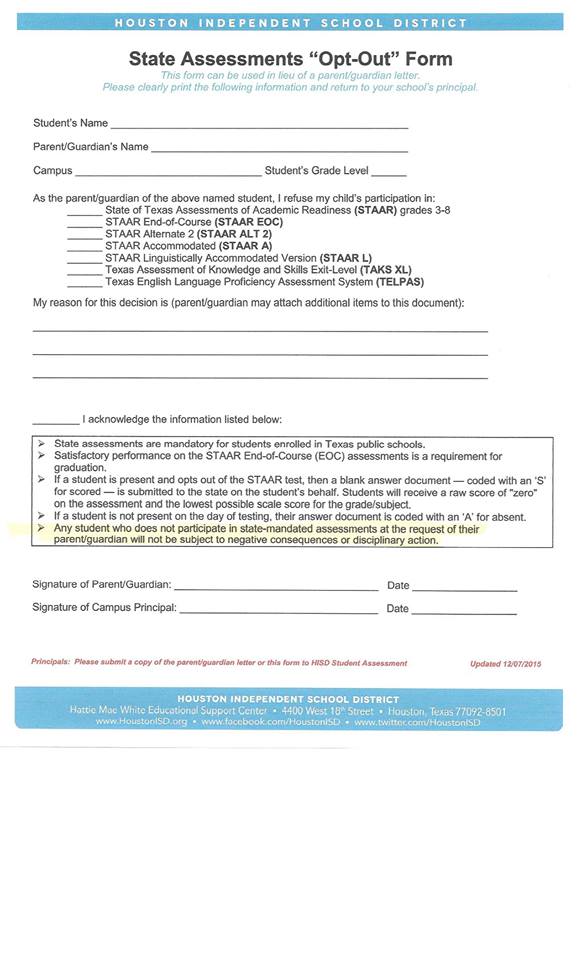
Update:  This is the official Houston ISD Opt Out form.  It is legal, people!  Demand your local schools respect your rights!12798821_10153991431898684_3910673097468946811_n

Houston ISD Continues to Mislead Parents

Activist parents in Houston ISD rightly celebrated when the HISD Board of Trustees became the first district (to our knowledge) to write Opt Out procedures into their board policies.  Further, the parents succeeded in convincing the board to suspend, at least for this year, the HISD specific policy which made STAAR passage a promotion standard for all pre-secondary grades 3-8.

However, apparently word of this hasn’t filtered through the district.  In a recent blog post, one Houston dad takes a look at continuing misleading and intimidating information coming from HISD schools.

HISD Intimidation or Incompetence?

Premier TX School Law Firm: Parents Can Opt Out (and Schools Can Excuse the Absence)

For readers of TPERN articles, you will recognize the name Walsh, Anderson.  Walsh, Anderson (now known as Walsh Gallego) is one of the largest (and arguably the most prestigious) education law firms in Texas.  They represent school districts across the state through multiple offices, speak at almost every school conference, and regularly provide guidance to school districts on difficult legal issues.  During the summer of 2014, after schools dealt with the first big wave of opt outs, Walsh, Anderson put together an “Opt Out Course for Schools.” which included a legal paper that contained various legal arguments against opting out.  Those same arguments now appear almost word for word in many letters districts send to intimidate parents.  They include the thoroughly discredited claim that the Attorney General has ruled that an assessment and a test are the same thing (it hasn’t).  When we posted the Walsh, Anderson handout that a school sent us, Walsh, Anderson made a copyright claim and demanded we take it down, even though schools post it all over the internet.  Notwithstanding the work Walsh, Anderson has done to arm schools with legal arguments to intimidate parents, we have always found them to be reasonable in working with parents to craft solutions that enable parents to make good educational decisions for their kids and allow the schools to meet their requirements under the state law.  And this is what good lawyers do: they help their clients find a way to do what they want to do.

Which raises the question: when a school decides to actively oppose Opt Out parents, is this something they do because the law requires them to, or is it a policy choice the school is making?  Because, quite often, schools will say the law requires them to take these stances.  That, of course, is nonsense.  We’ve always asserted that if a school district wishes to respect parental rights in the Opt Out process, a good lawyer can arm them with many tools to do exactly that while also protecting the school against allegations that it has not followed the TEA rules.  And knowing that the people at Walsh, Anderson are good and creative lawyers, our logical conclusion is that opposing parents is a local policy decision — not a result of the legal obligations of schools.

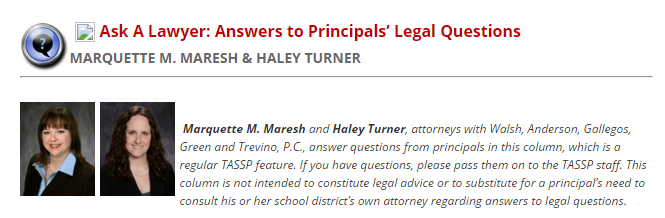
This conclusion was confirmed when we discovered an October 2014 “advice column” written by two Walsh, Anderson lawyers for the Texas Association of Secondary School Principals.  So that you understand this is coming from school lawyers and not TPERN, here is the intro biography to the column:

bios walsh

A principal wrote to the lawyers asking whether the school was required to report Opt Out absences as unexcused absences.  The Walsh, Anderson shareholder who responded not only gave the principal a route to excuse the absences, she also decided to explain opting out to other readers who may not have experienced it yet:

walsh excerpt

There you have it, in one simple sentence.  Putting everything else aside, the school lawyers know what TPERN and Opt Out parents state-wide have been saying for years: parents “technically” can opt out of STAAR.  But to take it a step further, schools can choose to excuse those absences!  Principals have wide discretion to decide what is an excused absence and what is not.  If a principal chooses to respect the rights of parents, he may mark STAAR opt out days as excused absences.

This column puts a school’s decision to fight opt out parents in a stark light.  Parents can opt out.  Schools can excuse the absences.  The decision to fight, intimidate and threaten does not come from the TEA.  It does not come from the school’s lawyers.  It is a local, policy decision.  A school’s hands are not tied.  They have a lot of discretion on how they treat parents.  It’s time to demand from your local school administration and trustees that schools respect parental decision-making.  In the meantime, if you get any blow-back from schools telling you that parents can’t opt out, just print out the column and give it to them with the note that according to Texas’s top school lawyers, you can.


Why I’m Not Going To Hold Your Hand This Year

With the recent TEA announcement that the passing standard for STAAR will rise this year, interest in the Opt Out movement has started even earlier than usual.  Parents around the state have found their kids have been pulled from electives and forcibly enrolled in test prep class periods.  School board meetings have been called to address over-preparation concerns in the first six weeks of school!  Students have started their own opt out page and the press has been talking about it.  As news of the increased passing standards hit, the Facebook Texas Opt Out page had nearly 1000 new likes in a week — numbers we don’t usually see until the first assessment window approaches.

On the Opt Out Facebook page, we see three types of posts from parents.  The first is the “how do I do it” post.  And we happily direct you to many resources, including txedrights.net, with guides and forms for your use.  The second type is what I call the “you can do it” post, from parents who have successfully opted out.  These posts usually relate their personal struggles with the school and how and why they overcame them.  But the third kind is the one I want to talk about.  That is the post that seeks reassurance that nothing bad will happen to you or your child if you opt out.  The last two years, I as a lawyer, and other moderators as opt out parents, have patiently and carefully explained to you the possibilities, the realities and the experiences that exist.  We have tried to separate the fiction that the schools spread and the myths that many parents believe, from the actual law and the processes as they actually exist.  We have been your cheerleaders, your counselors and your advocates.

For me, I’m not going to play that role anymore.  And I am not going to play it for one simple reason.  Careful, cautious engagement will not bring the kind of change we need.  We need radical, committed parents who are willing to stand up to the schools and say “I dare you.”  We need the kind of groundswell activism that led to tens of thousands of New York parents opting out even when the schools told them they can’t. We need the kind of fierce opposition that led to zero students in a Seattle high school showing up for their state assessment.  We need the kind of brave line-in-the-sand protests that saw Colorado students walk out of class in protest of a misguided assessment process.  In Texas, we like to talk tough.  We like to claim to be rugged individualists.  But when it comes to standing up for our kids, by and large we are sheep and cowards.

What we have been doing in Texas has brought the most incremental of changes.  And while the increments have been good increments, we are nowhere near undoing the STAAR assessment system.  We are not in a place where the next legislature will be pressured to reduce assessments to the minimum required by the federal government.  We are not in a place where our elected representatives will decide that the high stakes must be detached from assessment.  We are not in a place where school boards, teachers and even our own TEA will stand up and say “this is wrong” without fear that they will end up on the losing side of the outcome.

So while all cautious and scared parents will hopefully come along and join the Opt Out movement this year, you will have to do it without my help.  I’m not speaking for any other moderator in the group. They may feel differently.  But for me, I’ve had it.  I’ve had it with a system that exploits the fear of parents, and of parents that let themselves be exploited.  I’ve had it with people who mouth how bad they think the system is, but because their kid isn’t at risk of retention, go ahead and participate anyway, just to be sure their kid is taken care of.  (That’s called enabling, by the way.)

Everybody’s kid is being negatively impacted.  In the narrowing of curriculum, in the loss of recess time, in the removal of peers from electives (which narrows the depth of experience in any class) . . . this list goes on and on.  Your kid may pass STAAR, but he still suffers.  She may not stress over high stakes, but she goes to school with a bunch of overstressed kids.  Don’t you think that impacts her experience?  So, this year, I am not holding your hand anymore.

Cautious, fearful parent, I understand.  I get it.  Do what you think is right.  I’ve spent hundreds of hours the past two years explaining legal arguments, the real facts about retention and potential and actual outcomes just to see parents fold up and submit their kids to assessment. I am not going to invest my limited time in doing that anymore.

Here is the bottom line, and you can do with it what you will.  Yes, there is a CHANCE, that in SSI grades a school could retain your child if you opt out.  (Of course the same chance exists if they participate and fail the STAAR).  The reality is very different. 90%+ of STAAR failures are promoted.  Yes, there is a chance a school could pull your kid from an elective.  There is also a chance you can fight that and win.  Or not.  Deal with it.  You are either trying to take the system down or you are joining in its purposes and objectives.  Decide what is more important and do it.  I am not going to counsel you through your decision anxiety, because in the end you will either have the courage to stand up or decide that a 1% risk is unacceptable to you.  You don’t need me to explain the risks and realities for you to do that.  You just need to decide if you are on board or not.

This year is vital to reforming assessment in Texas.  The actions of parents this assessment season will inform the work of our legislators in 2017.  The more we resist, the more we demand of candidates a response to their position on assessment, the more we confront the system in a way that raises our public profile, the greater the opportunity for real change.  So my time will be spent supporting those who will confront the system, not those who want to make sure they will be safe.

If you are ready, we are here to help.  I hope I am way too busy come spring because of people making the right decision.

TPERN Responds to Houston ISD Warning Letter

The Houston Chronicle recently published an article noting that Houston ISD had sent a warning letter to parents who opted out of STAAR assessment.  The letter was full of legal and factual errors, but was also notable for its blatant declaration that mandatory summer school awaits all kids who have opted out of STAAR.  This is contrary to law.  TPERN’s response is found below.  This response will be sent to Houston ISD, the Chronicle and Houston CVPE.

Regarding the recent article:  HISD letter warns parents against opting out of tests (4/24/15)

In the Chronicle’s coverage of the CVPE alternative learning event, the following quote correctly summarized the ability of parents to refuse standardized assessment for their children.

“”The fact is parents can request their child be removed from standardized testing,” said Elaina Polsen, executive director of communications with Clear Creek ISD”.

Unfortunately, Houston ISD apparently cannot comprehend that there is no method in statute to force assessment.  Parents cannot and will not be compelled to submit to standardized assessment of their children.  Instead, Houston ISD and Mr. Gohl have chosen the route of fear-mongering and intimidation to try to persuade parents to provide data on an assessment that has serious validity issues.  In so doing, however, Mr. Gohl has apparently announced that it is Houston ISD, and not the parents, that will refuse to follow the Education Code.  Such a posture is intolerable, and Mr. Gohl or those who formulated this illegal policy should be immediately terminated.  Lawless behavior should not be rewarded with a paycheck from the taxpayers.

I refer to the following line from Mr. Gohl’s letter to the parents of opt-out kids.  “[S]tudents will be required to attend summer school and will be reevaluated by the Grade Placement Committee prior to the end of summer school for a determination of promotion or retention.”  Mr. Gohl even bolded and underlined “attend summer school” so parents would know he is serious.  Mr. Gohl is not following the law.

Section 28.0211(c) of the Texas Education Code provides:

After a student fails to perform satisfactorily on an assessment instrument a second time, a grade placement committee shall be established to prescribe the accelerated instruction the district shall provide to the student before the student is administered the assessment instrument the third time.  The grade placement committee shall be composed of the principal or the principal’s designee, the student’s parent or guardian, and the teacher of the subject of an assessment instrument on which the student failed to perform satisfactorily.” (emphasis added).

Now, the second administration has not occurred yet.  As a result, no Grade Placement Committees have been formed and no course of accelerated instruction can have been prescribed.  Indeed, the parent is a member of the committee and must be involved in developing the Accelerated Instruction plan.  Yet, Mr. Gohl seems to suggest that the decision has been made.  Summer school is required . . . for everyone.  If this is the case, Houston ISD is in plain violation of the law, and has not prescribed a valid accelerated instruction plan.  I would suggest that if Houston ISD is concerned about following the Education Code, it look at itself first.  Get rid of petty bureaucrats like Mr. Gohl who think that the law does not apply to them.

I would also note that a one size fits all summer school prescription goes against everything the concept of Accelerated Instruction is intended to address.  The TEA’s Student Success Initiative Manual is clear on this:

Neither the law nor the rules specify the amount of time to be provided for the accelerated instruction. To support the SSI grade-advancement requirements, the law and the commissioner’s rules provide districts and charter schools with flexibility to determine on an individual student basis the appropriate form, content, and timing of the accelerated instruction. The policy governing accelerated instruction is intended to allow districts flexibility to meet individual student needs.” (p. 33).

The idea the summer school is required for STAAR failures is a myth.  The idea that schools can unilaterally impose it is a myth.  Mr. Gohl knows this, but he chooses to ignore the law and try to scare parents into submitting their kids for assessment.

This type of behavior by a public servant is intolerable and I call on the Houston ISD to repudiate it immediately.

Sincerely,


R. Scott Placek
Chairman
Texas Parents’ Educational Rights Network

Note: This response does not address numerous other legal errors contained in the letter from Houston ISD.

Update:  Houston ISD has admitted the letter to Opt Out parents contained errors regarding required summer school.  The blame this on an editing error.  Full article here.

Five Responses When The School Says 26.010 Means You Can’t Opt Out

It’s that time of year.  Schools are sending around copies of Tex. Ed. Code sec. 26.010, accusing Opt Out groups of misleading parents, and trying to coerce people into subjecting their kids to assessments.  Don’t be a sheep.  The TEA’s interpretation of Tex. Education Code sec. 26.010 has never been affirmed by any court.  This is just what they hope it means.  There are strong legal construction arguments which indicate that the TEA is wrong.  Here are five different responses to the 26.010 argument.  If the TEA or any school district lawyer can provide a case that says any of these are incorrect, let’s see it.

Five Responses When the School Cites 26.010 Saying It Prohibits Opt Out

1 – The STAAR is not a test; it is an assessment. STAAR is created by Chapter 39 of the Education Code which refers to it as an assessment over 450 times, while referring to other testing instruments as tests. The Legislature is presumed to intend the words that it chooses. By choosing to call STAAR an Assessment and not a Test, the Legislature precludes the school from relying on the “avoid a test” portion of 26.010.

2 – Chapter 26, taken as a whole, shows STAAR is not a test. Chapter 26 contains parental rights provisions, including the right to access various curricular material. It contains a separate section for access to assessments (26.005) and access to tests (26.006). Thus, in the same chapter as 26.010, the legislature clearly indicates that there is a difference between assessments and tests. You can’t conveniently conflate the two concepts when the legislature has purposely distinguished them.

3 – Access to STAAR is available to parents only through 26.005 and not 26.006. Apart from the definitional issue, the practical reality shows that STAAR is not a test. If STAAR were a test, schools would be required to provide parents access on school premises under 26.006. They do not and cannot. The only access is from the TEA under 26.005. If you get a 26.010 letter from the school try this response: “Dear School: If STAAR is a test, I demand access to it after my child takes it at the school under Texas Education Code 26.006. If you cannot provide me a date to examine the STAAR assessment at the school within 30 days, I will presume that you do not really believe it is a test.” (Update for 2019: Although this point is still technically true, with the addition of STAAR questions to the parent portal, the difference in access is much less stark.  For that reason I’d don’t suggest using this tactic, other than to note what is stated in the first sentence).

4 – My purpose is not to avoid a test. Section 26.010 is written in terms of purpose and not effect. A parent can’t invoke 26.010 to avoid tests. They can invoke 26.010 on the basis of their religious or moral beliefs, and that may result in a missed test. If the school’s interpretation were correct, parents could opt their child out of sex ed classes, but then be required to return to the class and view graphic anatomical charts on a test. That is not how 26.010 works and the schools know it. They are simply reading it that way to coerce parents into letting their kids be assessed.

5 – Subsection (b) does not limit opt out rights. Subsection (b) simply codifies the fact that parents who choose to opt out must still satisfy grade level or graduation requirements. Reading (b) as a limitation on (a) even though it contains no limiting language or exception language is sloppy lawyering.  It indicates a desire to reach an outcome, not analyze an issue.  Since substitute assessments and GPC processes exist to accomplish both promotion and graduation requirements, subsection (b) cannot be read as a limitation on the right to Opt Out of an assessment, even if that was the intent of the subsection! In fact, the better argument is that the existence of subsection (b) shows that parents can opt out but must still meet grade level or graduation requirements of the school.

A Great Refusal Letter

Here is refusal letter a mom from GPISD shared with us! I’d love to see how the school responds to this!

Dear (school name protected) Administrators and Teachers:
My name is [parent name]. I’m a mother of a 5th grader in GPISD. It was suggested to me that I contact you to discuss my concerns about STAAR testing. I will be honest about how I feel about STAAR, but I seek guidance about how to approach the issues at hand. I don’t like the STAAR test, I don’t agree with and I certainly don’t approve of the curriculum that comes with it. As I mentioned, my daughter is in 5th grade and was diagnosed with double-deficit Dyslexia late last year. Since that time, she has failed all of her STAAR tests. The stress she’s already feeling about testing causes her to lose sleep, get headaches and stomach aches. She spends more time than her peers just trying to keep up, but still is falling behind. I have pushed to have her tested for other learning disabilities and that is in the works, but hasn’t happened yet. She has two first year teachers this year, one for reading, one for math and her science teacher has been out on maternity leave, so she has had a sub the last few weeks. She went several weeks without any math instruction at all because her Dyslexia class interfered with instructional time for math.
As a parent, I feel that it is my responsibility to protect my children from anything I deem as harmful and I strongly feel that the STAAR test is harmful, not only for my child, but for EVERY child, however, I only have the ability to protect my own. I don’t want my daughter to take the test, but I also understand that she’s in a “critical” year for testing, which puts me in a quandry. It is my understanding that the 5th grade kids must pass reading this year to be promoted to 6th grade. Based on what I’ve seen with the homework she brings home and the struggles she has with it, I feel pretty certain that she won’t pass it. Nor do I feel she will pass the math or science! The structure of this test is developmentally inappropriate for their ages! I have two older children and neither of them, nor myself, are capable of understanding some of the assignments nor the method of teaching that is being conveyed to my 5th grader, and I assure you that it’s not due to lack of intelligence!
This assessment means absolutely nothing to me. It doesn’t measure intelligence, nor does it measure teaching or learning ability, so why is it so critical? Because the State says it is!
Here’s my quandry…I know what my rights are, but I want to know what stance GPISD takes and if her school and district administrators will support my daughter and I or are they going to fight us.
Do I allow my child to take the test, knowing the physical, emotional and psychological damage it causes her along with the physical illness it creates, knowing the likelihood of her passing is slim, or do I do what my maternal instinct is telling me and refuse for her to take it? Will I have support from GPISD or will GPISD challenge me, making things even more difficult for my daughter and myself? Do I continue to allow my daughter to be made to feel like she doesn’t matter, that she has no value because she can’t pass an insignificant test? I have always taught my children to stand up for what they believe in and what is right, even if that means they stand alone, so doesn’t that mean I should lead by example? I have always taught my children to always do their best in everything they do. Do I allow my daughter to continue to feel like a failure, even though she is doing her best? Is GPISD going to tell my daughter that her best isn’t good enough?
I feel that whatever direction I choose to go, it could potentially negatively impact my daughter and I don’t want that. She faces more than enough challenges at this age and certainly doesn’t need anymore.
The more I write, the more concrete I feel in making my decision. I must use my voice to protect my child until she is capable of using her own. With all due respect (and I DO highly respect each of you and your positions), please let this serve as formal notice that my daughter, (name protected) will abstain from taking any and all STAAR tests this year.
Please know that I have not made my decision lightly. In fact, it has caused me a great deal of turmoil. However, I must do what I feel is best for my daughter and since GPISD is funded by the State of Texas and must follow their rules, I’m taking that power away and making the decision myself. My daughter’s self-worth cannot be measured by a test score or monetary value. I only hope that one day, the State of Texas and GPISD will feel the same way and allow the school administrators and educators to do their jobs and provide our children the true education that they so richly deserve.
Please advise me in advance of what instruction will be provided for her on testing days and feel free to contact me with any questions or concerns.
Respectfully,
[Mom]

Stop Waiting for Permission; Make Your Own Decisions

If you are asking about Opting Out, as a parent you have already reached certain conclusions. Maybe you believe the STAAR has had a negative effect on curriculum and you can’t support it. Maybe you find it developmentally inappropriate. Maybe you have seen the physical and emotional toll it takes on kids and don’t want to subject your child to that. Maybe you just don’t like outsourcing the assessment of Texas school kids to a foreign corporation. Whatever the reason, if you are asking about Opting Out, you’ve either reached those conclusions, or you are concerned enough about some issue to want to take action. So what are you waiting for?

If you are waiting on permission from your school before deciding to Opt Out of the STAAR test, let me save you some time. You won’t get it. The TEA has given districts their marching orders. They are to tell all parents that it is not permitted, ever, under any circumstances. Nevermind the hundreds or thousands of parents who opted out last year. Never mind all the voices who post on this forum and will tell you they Opted Out with no consequences. Nevermind the TEA telling them they can accept refusals.  If you want your school’s permission, you don’t really want to Opt Out. What you want is to be excused. You want the school to do your job for you. They are usually all too happy to parent your child for you. That is, as long as it fits their rules. Since Opting Out doesn’t fit their rules, they won’t handle that part of it for you. You have to do the hard work.

2024 Update: The TEA has told schools they can accept parental refusals and not put the assessment in front of the student. THE DECISION TO OPPOSE YOU IS A LOCAL DECISION

What’s the hard work? The hard work is being a parent. The hard work is giving the school more respect than they give you and letting them know your decision. The hard work is listening to them lie and say that parents can’t opt their child out. The hard work is politely telling them that you weren’t asking their permission but have already decided. The hard work is letting them know that you understand the state ties their hands – that you don’t hold that against them and that you are sure they don’t hold your decision against you. The hard work is figuring out whether to refuse by staying home or by telling your child just not to fill out the test forms. The hard work being an advocate for your child if the school is upset by your decision.

The hard work is informing yourself and not taking any threats at face value. If they tell you your child will be retained, ask them why the TEA has published a website saying STAAR isn’t a promotion requirement anymore..   If they tell you that your child has to be tested on a makeup day, tell them you know it’s a district option and that you want your child in class even if it means they “grade” the refused assessment. If they tell you the state requires them to put the assessment in front you the student if they are at school, tell them the TEA says that isn’t true and SHOW THEM the truth.  If they tell you that you have to withdraw your child to avoid STAAR, tell them you know that’s not true. They can’t show you a law or regulation that says so.

We’ve EXPLAINED to you that they aren’t going to agree.  We’ve SHOWN you what you need to do when they don’t.  So when they write back and say you can’t opt out, put on your adult pants and ACT.  You know that parents have been opting out for a decade without the state patting them on the head and saying it is OK.  Either you want to opt out or you want permission.  Which is it?

We are here to support you. We’ll fight for you if you want. But what we can’t do is give you the backbone to do what you already know is right. Only you can do that hard work. You’ll have amazing support and cheering crowds. Your kids will have what they deserve. But not if you wait for permission. You don’t ask the school for permission on any of your other child rearing decisions. Why do you want it now?

Updated: April 12, 2024